Showing posts with label GLE. Show all posts

Friday, September 20, 2013

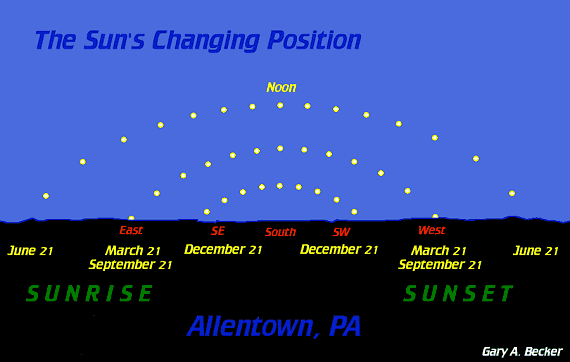
4th Grade Connections: NGSS and the MO GLEs

Keeping the trend, this is the third of many to highlight the connections between the Missouri Grade Level Expectations and the Next Generation Science Standards.

Kindergarten

1st Grade

2nd Grade

3rd Grade

These are my connections only, should you find an error or find I missed something PLEASE add your thoughts in the comments.

The intention is for this to be a resource for others making the transition to these new expectations.

Resources used:

NGSS Unit: Waves

NGSS Standards:

  • 4-PS4-1. Develop a model of waves to describe patterns in terms of amplitude and wavelength and that waves can cause objects to move.
  • 4-PS4-3. Generate and compare multiple solutions that use patterns to transfer information.

Corresponding Missouri GLEs

2nd Grade
1.2.A Scope and Sequence – Forms of Energy: Sound
a. Identify air, water, and solids as mediums that sound travels through
b. Describe different ways to change the pitch of a sound (i.e., changes in size, such as length or thickness, and in tightness/tension of the source)
c. Describe how the ear serves as a receiver of sound (i.e., sound vibrates eardrum)
d. Describe how to change the loudness of a sound (i.e., increase or decrease the force causing vibrations)

4th Grade
7.1.A Scope and Sequence - All Units
a. Formulate testable questions and explanations (hypotheses)
b. Recognize the characteristics of a fair and unbiased  test
c. Conduct a fair test to answer a question

7.1.B Scope and Sequence - All Units
a. Make qualitative observations using the five senses
b. Make observations using simple tools and equipment (e.g., hand lenses, magnets, thermometers, metric rulers, balances, graduated cylinders, spring scale)
c. Measure length to the nearest centimeter, mass using grams, temperature using degrees Celsius, volume to the nearest milliliter, force/weight to the nearest Newton
d. Compare amounts/measurements  
e. Judge whether measurements and computation of quantities are reasonable

7.1.C Scope and Sequence - All Units
a. Use quantitative and qualitative data as support for reasonable
explanations
b. Use data as support for observed patterns and relationships, and to make predictions to be tested
c. Evaluate the reasonableness of an explanation 
d. Analyze whether evidence supports proposed explanations

7.1.D Scope and Sequence - All Units
a. Communicate the procedures and results of investigations and explanations through:
oral presentations
drawings and maps
data tables 
graphs (bar, single line, pictograph)
writings

8.2.A Scope and Sequence – All units
a. Research biographical information about various scientists and inventors from different gender and ethnic backgrounds, and describe how their work contributed to science and technology
(Assess Locally)

8.3.A Scope and Sequence - All Units
a. Identify a question that was asked, or could be asked, or a problem that needed to be solved when given a brief scenario (fiction or nonfiction of people working alone or in groups solving everyday problems or learning through discovery)
b. Work with a group to solve a problem, giving due credit to the ideas and contributions of each group member (Assess Locally)

NGSS Unit: Structure, Function and Information Processing

NGSS Standards:

  • 4-PS4-2. Develop a model to describe that light reflecting from objects and entering the eye allows objects to be seen.
  • 4-LS1-1. Construct an argument that plants and animals have internal and external structures that function to support survival, growth, behavior, and reproduction. 
  • 4-LS1-2. Use a model to describe that animals receive different types of information through their senses, process the information in their brain, and respond to the information in different ways.

Corresponding Missouri GLEs

Kindergarten
3.1.D Scope and Sequence – Plants and Animals
a. Observe and compare the structures and behaviors of different kinds of plants and animals.

1st Grade
3.1.D Scope and Sequence – Characteristics of Plants and Animals
a. Identify and compare the physical structures of a variety of plants (e.g., stem, leaves, flowers, seeds, roots)
b. Identify and compare the physical structures of a variety of animals (e.g., sensory organs, beaks, appendages, body covering) (Do NOT assess terms: sensory organs, appendages)
c. Identify the relationships between the physical structures of plants and the function of those structures (e.g., absorption of water, absorption of light energy, support, reproduction)
d. Identify the relationships between the physical structures of animals and the function of those structures (e.g., taking in water, support, movement, obtaining food, reproduction)

3rd Grade
1.2.A Scope and Sequence – Earth, Sun, and Moon
a. Identify sources of light energy (e.g., Sun, bulbs, flames)
b. Observe light being transferred from the source to the receiver (eye) through space
c. Identify the three things (light source, object, and surface) necessary to produce a shadow

3.1.D Scope and Sequence – Plants
a. Identify the major organs (roots, stems, flowers, leaves) and their functions in vascular plants (e.g., absorption, transport, reproduction) (Do  NOT assess the term vascular

3.2.C Scope and Sequence – Plants
a. Illustrate and trace the path of water and nutrients as they move through the transport system of a plant

4.2.A Scope and Sequence – Food Chains
a. Identify sunlight as the primary source of energy plants use to produce their own food

4th Grade
7.1.A Scope and Sequence - All Units
a. Formulate testable questions and explanations (hypotheses)
b. Recognize the characteristics of a fair and unbiased  test
c. Conduct a fair test to answer a question

7.1.B Scope and Sequence - All Units
a. Make qualitative observations using the five senses
b. Make observations using simple tools and equipment (e.g., hand lenses, magnets, thermometers, metric rulers, balances, graduated cylinders, spring scale)
c. Measure length to the nearest centimeter, mass using grams, temperature using degrees Celsius, volume to the nearest milliliter, force/weight to the nearest Newton
d. Compare amounts/measurements  
e. Judge whether measurements and computation of quantities are reasonable

7.1.C Scope and Sequence - All Units
a. Use quantitative and qualitative data as support for reasonable
explanations
b. Use data as support for observed patterns and relationships, and to make predictions to be tested
c. Evaluate the reasonableness of an explanation 
d. Analyze whether evidence supports proposed explanations

7.1.D Scope and Sequence - All Units
a. Communicate the procedures and results of investigations and explanations through:
oral presentations
drawings and maps
data tables 
graphs (bar, single line, pictograph)
writings

8.2.A Scope and Sequence – All units
a. Research biographical information about various scientists and inventors from different gender and ethnic backgrounds, and describe how their work contributed to science and technology
(Assess Locally)

8.3.A Scope and Sequence - All Units
a. Identify a question that was asked, or could be asked, or a problem that needed to be solved when given a brief scenario (fiction or nonfiction of people working alone or in groups solving everyday problems or learning through discovery)
b. Work with a group to solve a problem, giving due credit to the ideas and contributions of each group member (Assess Locally)

5th Grade
1.2 A Scope and Sequence – Solar System
a. Observe and explain light being transferred from the source to the receiver (eye) through space in straight lines
b. Observe and explain how an object (e.g., moon, mirror, objects in a room) can only be seen when light is reflected from that object to the receiver (eye) 

NGSS Unit: Energy

NGSS Standards:

  • 4-PS3-1. Use evidence to construct an explanation relating the speed of an object to the energy of that object. 
  • 4-PS3-2. Make observations to provide evidence that energy can be transferred from place to place by sound, light, heat, and electric currents. 
  • 4-PS3-3. Ask questions and predict outcomes about the changes in energy that occur when objects collide. 
  • 4-PS3-4. Apply scientific ideas to design, test, and refine a device that converts energy from one form to another
  • 4-ESS3-1. Obtain and combine information to describe that energy and fuels are derived from natural resources and their uses affect the environment.

Corresponding Missouri GLEs

Kindergarten
1.2.A Scope and Sequence – Investigating Sound
a. Identify the sounds and their source of vibrations in everyday life (e.g., alarms, car horns, animals, machines, musical instruments)
b. Compare different sounds (i.e., loudness, pitch, rhythm)
c. Identify the ear as a receiver of vibrations that produce sound

1st Grade
2.1.A Scope and Sequence – Investigating Motion
a. Compare the position of an object relative to another object (e.g., left of or right of)
b. Describe an object’s motion as straight, circular, vibrating (back and forth), zigzag, stopping, starting, or falling
c. Compare the speeds (faster vs. slower) of two moving objects

2nd Grade
1.2.A Scope and Sequence – Forms of Energy: Sound
a. Identify air, water, and solids as mediums that sound travels through
b. Describe different ways to change the pitch of a sound (i.e., changes in size, such as length or thickness, and in tightness/tension of the source)
c. Describe how the ear serves as a receiver of sound (i.e., sound vibrates eardrum)
d. Describe how to change the loudness of a sound (i.e., increase or decrease the force causing vibrations)

8.1.A Scope and Sequence – Forms of Energy: Sound
a. Design and construct a musical instrument using materials (e.g., cardboard, wood, plastic, metal)  and/or existing objects (e.g., toy wheels, gears, boxes, sticks) that can be used to perform a task (Assess Locally)

3rd Grade
1.2.A Scope and Sequence – Earth, Sun, and Moon
a. Identify sources of light energy (e.g., Sun, bulbs, flames)
b. Observe light being transferred from the source to the receiver (eye) through space
c. Identify the three things (light source, object, and surface) necessary to produce a shadow

4th Grade
1.2.F Scope and Sequence – Forms of Energy: Electrical Circuits
a. Identify the evidence of energy transformations (temperature change, light, sound, motion, and magnetic effects) that occur in electrical circuits

2.1.A Scope and Sequence – Laws of Motion
a. Classify different types of motion [straight line, curved, vibrating (back and forth)]
b. Describe an object’s motion in terms of distance and time

2.2.D Scope and Sequence – Laws of Motion
a. Observe that balanced forces do not affect an object’s motion (need to clarify that balanced forces means no change in forces acting on an object)
b. Describe how unbalanced forces acting on an object changes its speed (faster/slower), direction of motion, or both (need to clarify that unbalanced forces means any change in forces acting on an object)
c. Predict how the change in speed of an object (i.e., faster/slower/remains the same) is affected by the amount of force applied to an object and the mass of the object

7.1.A Scope and Sequence - All Units
a. Formulate testable questions and explanations (hypotheses)
b. Recognize the characteristics of a fair and unbiased  test
c. Conduct a fair test to answer a question

7.1.B Scope and Sequence - All Units
a. Make qualitative observations using the five senses
b. Make observations using simple tools and equipment (e.g., hand lenses, magnets, thermometers, metric rulers, balances, graduated cylinders, spring scale)
c. Measure length to the nearest centimeter, mass using grams, temperature using degrees Celsius, volume to the nearest milliliter, force/weight to the nearest Newton
d. Compare amounts/measurements  
e. Judge whether measurements and computation of quantities are reasonable

7.1.C Scope and Sequence - All Units
a. Use quantitative and qualitative data as support for reasonable
explanations
b. Use data as support for observed patterns and relationships, and to make predictions to be tested
c. Evaluate the reasonableness of an explanation 
d. Analyze whether evidence supports proposed explanations

7.1.D Scope and Sequence - All Units
a. Communicate the procedures and results of investigations and explanations through:
oral presentations
drawings and maps
data tables 
graphs (bar, single line, pictograph)
writings

8.2.A Scope and Sequence – All units
a. Research biographical information about various scientists and inventors from different gender and ethnic backgrounds, and describe how their work contributed to science and technology
(Assess Locally)

8.3.A Scope and Sequence - All Units
a. Identify a question that was asked, or could be asked, or a problem that needed to be solved when given a brief scenario (fiction or nonfiction of people working alone or in groups solving everyday problems or learning through discovery)
b. Work with a group to solve a problem, giving due credit to the ideas and contributions of each group member (Assess Locally)

NGSS Unit: Earth's Systems: Processes that Shape the Earth

NGSS Standards:

  • 4-ESS1-1 Identify evidence from patterns in rock formations and fossils in rock layers to support an explanation for changes in a landscape over time. 
  • 4-ESS2-1. Make observations and/or measurements to provide evidence of the effects of weathering or the rate of erosion by water, ice, wind, or vegetation. 
  • 4-ESS2-2. Analyze and interpret data from maps to describe patterns of Earth’s features. 
  • 4-ESS3-2. Generate and compare multiple solutions to reduce the impacts of natural Earth processes on humans.

Corresponding Missouri GLEs

Kindergarten
1.1.A Scope and Sequence – Properties of Matter
a. Describe physical properties of objects (i.e., size, shape, color, mass) by using the senses, simple tools (e.g., magnifiers, equal arm balances), and/or nonstandard measures (e.g., bigger/smaller; more/less)
b. Identify materials (e.g., cloth, paper, wood, rock, metal) that make up an object and some of the physical properties of the materials (e.g., color, texture, shiny/dull, odor, sound, taste, flexibility)
c. Sort objects based on observable physical properties (e.g., size, material, color, shape, mass)

2nd Grade
5.1.A Scope and Sequence -  Earth Materials: Rocks and Minerals
a. Observe and describe the physical properties (e.g., odor, color, appearance, relative grain size, texture, absorption of water) and different components (i.e., sand, clay, humus) of soils
b. Observe and describe the physical properties of rocks (e.g., size, shape, color, presence of fossils)

5.2.A Scope and Sequence – Earth Materials: Rocks and Minerals
a. Observe and identify examples of slow changes in the Earth’s surface and surface materials (e.g., rock, soil layers) due to processes such as decay (rotting), freezing, thawing, breaking, or wearing away by running water or wind

5.3.A Scope and Sequence – Earth materials: Rocks and Soil
a. Observe and describe ways humans use Earth’s materials (e.g., soil, rocks) in a daily life

4th Grade
5.1.A Scope and Sequence – Changes in the Earth’s Surface
a. Identify and describe the components of soil (e.g., plant roots and debris, bacteria, fungi, worms, types of rock) and its properties (e.g., odor, color, resistance to erosion, texture, fertility, relative grain size, absorption rate)
b. Compare the physical properties (i.e., size, shape, color, texture, layering, presence of fossils) of rocks (mixtures of different Earth materials, each with observable physical properties

5.2.A Scope and Sequence-  Changes in the Earth’s Surface
a. Observe and describe the breakdown of plant and animal material into soil through decomposition processes (i.e., decay/rotting, composting, digestion)
b. Identify the major landforms/bodies of water on Earth (i.e., mountains, plains, river valleys, coastlines, canyons)
c.  Describe how weathering agents (e.g., water, chemicals, temperature, wind, plants) cause surface changes that create and/or change Earth’s surface materials and/or landforms/ bodies of water
d.  Describe how erosion processes (i.e., action of gravity, waves, wind, rivers, glaciers) cause surface changes that create and/or change Earth’s surface materials and/or landforms/ bodies of water
e.  Relate the type of landform/water body to the process by which it was formed

5.3.A Scope and Sequence – Changes in the Earth’s Surface
a. Identify the ways humans affect the erosion and deposition of Earth’s materials (e.g., clearing of land, planting vegetation, paving land construction of new buildings)
b. Propose ways to solve simple environmental problems (e.g., recycling, composting, ways to decrease soil erosion) that result from human activity

7.1.A Scope and Sequence - All Units
a. Formulate testable questions and explanations (hypotheses)
b. Recognize the characteristics of a fair and unbiased test
c. Conduct a fair test to answer a question

7.1.B Scope and Sequence - All Units
a. Make qualitative observations using the five senses
b. Make observations using simple tools and equipment (e.g., hand lenses, magnets, thermometers, metric rulers, balances, graduated cylinders, spring scale)
c. Measure length to the nearest centimeter, mass using grams, temperature using degrees Celsius, volume to the nearest milliliter, force/weight to the nearest Newton
d. Compare amounts/measurements  
e. Judge whether measurements and computation of quantities are reasonable

7.1.C Scope and Sequence - All Units
a. Use quantitative and qualitative data as support for reasonable
explanations
b. Use data as support for observed patterns and relationships, and to make predictions to be tested
c. Evaluate the reasonableness of an explanation 
d. Analyze whether evidence supports proposed explanations

7.1.D Scope and Sequence - All Units
a. Communicate the procedures and results of investigations and explanations through:
oral presentations
drawings and maps
data tables 
graphs (bar, single line, pictograph)
writings

8.2.A Scope and Sequence – All units
a. Research biographical information about various scientists and inventors from different gender and ethnic backgrounds, and describe how their work contributed to science and technology
(Assess Locally)

8.3.A Scope and Sequence - All Units
a. Identify a question that was asked, or could be asked, or a problem that needed to be solved when given a brief scenario (fiction or nonfiction of people working alone or in groups solving everyday problems or learning through discovery)
b. Work with a group to solve a problem, giving due credit to the ideas and contributions of each group member (Assess Locally)


Monday, September 9, 2013

2nd Grade Connections: NGSS to MO GLEs

Keeping the trend, this is the third of many to highlight the connections between the Missouri Grade Level Expectations and the Next Generation Science Standards.  

Kindergarten


1st Grade


These are my connections only, should you find an error or find I missed something please add your thoughts in the comments.


The intention is for this to be a resource for others making the transition to these new expectations.


Resources used:


  1. Next Generation Science Standards 
  1. Missouri Grade Level Expectations

NGSS Unit 1: Structure and Properties of Matter

NGSS Standards

2-PS1-1. Plan and conduct an investigation to describe and classify different kinds of materials by their observable properties. 
2-PS1-2. Analyze data obtained from testing different materials to determine which materials have the properties that are best suited for an intended purpose
2-PS1-3. Make observations to construct an evidence-based account of how an object made of a small set of pieces can be disassembled and made into a new object
2-PS1-4. Construct an argument with evidence that some changes caused by heating or cooling can be reversed and some cannot.

Corresponding Missouri GLEs

Kindergarten
1.1.A Scope and Sequence – Properties of Matter
a. Describe physical properties of objects (i.e., size, shape, color, mass) by using the senses, simple tools (e.g., magnifiers, equal arm balances), and/or nonstandard measures (e.g., bigger/smaller; more/less)
b. Identify materials (e.g., cloth, paper, wood, rock, metal) that make up an object and some of the physical properties of the materials (e.g., color, texture, shiny/dull, odor, sound, taste, flexibility)
c. Sort objects based on observable physical properties (e.g., size, material, color, shape, mass)

2nd Grade
7.1.A Scope and Sequence - All Units
a. Pose questions about objects, materials, organisms and events in the environment
b. Plan and conduct a simple investigation (fair test) to answer a question

7.1.B Scope and Sequence - All Units
a. Make qualitative observations using the five senses
b. Make observations using simple tools and equipment (e.g., magnifiers/hand lenses, magnets, equal arm balances, thermometers)
c. Measure length, mass, and temperature using standard and non-standard units
d. Compare amounts/measurements

7.1.C Scope and Sequence - All Units
a. Use observations as support for reasonable explanations
b. Use observations to describe relationships and patterns and to make predictions to be tested
c. Compare explanations with prior knowledge

7.1.D Scope and Sequence - All Units
a. Communicate simple procedures and results of investigations and explanations through:
oral presentations
drawings and maps
data tables
graphs (bar, pictograph)
writings

8.3.A Scope and Sequence - All Units
a. Identify a question that was asked, or could be asked, or a problem that needed to be solved when given a brief scenario (fiction or nonfiction of individuals solving everyday problems or learning through discovery)
b. Work with a group to solve a problem, giving due credit to the ideas and contributions of each group member (Assess Locally)

3rd Grade
1.1.D Scope and Sequence – Investigating States of Matter
a. Compare the observable physical properties of solids, liquids, or gases (air) (i.e., visible vs. invisible, changes in shape, changes in the amount of space occupied)
b. Identify everyday objects/substances as solid, liquid, or gas (e.g., air, water)
c. Observe and identify that water evaporates (liquid water changes into a gas as it moves into the air)
d. Measure and compare the temperature of water when it exists as a solid to its temperature when it exists as a liquid
e. Investigate and observe that water can change from a liquid to a solid (freeze), and back again to a liquid (melt), as the result of temperature changes
f. Describe the changes in the physical properties of water (i.e., shape, volume) when frozen or melted
g. Predict and investigate the effect of heat (thermal energy) (i.e., change in temperature, melting, evaporation) on objects and materials

NGSS Unit 2: Processes that Shape the Earth

NGSS Standards

2-ESS1-1. Make observations from media to construct an evidence-based account that Earth events can occur quickly or slowly. 
2-ESS2-1. Compare multiple solutions designed to slow or prevent wind or water from changing the shape of the land.
2-ESS2-2. Develop a model to represent the shapes and kinds of land and bodies of water in an area. 
2-ESS2-3. Obtain information to identify where water is found on Earth and that it can be solid or liquid.

Corresponding Missouri GLEs

2nd Grade
5.2.A Scope and Sequence – Earth Materials: Rocks and Minerals
a. Observe and identify examples of slow changes in the Earth’s surface and surface materials (e.g., rock, soil layers) due to processes such as decay (rotting), freezing, thawing, breaking, or wearing away by running water or wind

7.1.A Scope and Sequence - All Units
a. Pose questions about objects, materials, organisms and events in the environment
b. Plan and conduct a simple investigation (fair test) to answer a question

7.1.B Scope and Sequence - All Units
a. Make qualitative observations using the five senses
b. Make observations using simple tools and equipment (e.g., magnifiers/hand lenses, magnets, equal arm balances, thermometers)
c. Measure length, mass, and temperature using standard and non-standard units
d. Compare amounts/measurements

7.1.C Scope and Sequence - All Units
a. Use observations as support for reasonable explanations
b. Use observations to describe relationships and patterns and to make predictions to be tested
c. Compare explanations with prior knowledge

7.1.D Scope and Sequence - All Units
a. Communicate simple procedures and results of investigations and explanations through:
oral presentations
drawings and maps
data tables
graphs (bar, pictograph) 
writings

8.3.A Scope and Sequence - All Units
a. Identify a question that was asked, or could be asked, or a problem that needed to be solved when given a brief scenario (fiction or nonfiction of individuals solving everyday problems or learning through discovery)
b. Work with a group to solve a problem, giving due credit to the ideas and contributions of each group member (Assess Locally)
3rd Grade
5.1.C Scope and Sequence – Investigating States of Matter
a. Identify that liquid water can be changed into a gas (vapor) in the air.
b. Identify that clouds are composed of tiny droplets of water
c. Identify air as a substance that surrounds us, taking up space and moves around us as wind

5.2.E Scope and Sequence – Investigating States of Matter
a. Describe clouds and precipitation as forms of water

4th Grade
5.2.A Scope and Sequence-  Changes in the Earth’s Surface
a. Observe and describe the breakdown of plant and animal material into soil through decomposition processes (i.e., decay/rotting, composting, digestion)
b. Identify the major landforms/bodies of water on Earth (i.e., mountains, plains, river valleys, coastlines, canyons)
c. Describe how weathering agents (e.g., water, chemicals, temperature, wind, plants) cause surface changes that create and/or change Earth’s surface materials and/or landforms/ bodies of water
d. Describe how erosion processes (i.e., action of gravity, waves, wind, rivers, glaciers) cause surface changes that create and/or change Earth’s surface materials and/or landforms/ bodies of water
e. Relate the type of landform/water body to the process by which it was formed

5.3.A Scope and Sequence – Changes in the Earth’s Surface
a. Identify the ways humans affect the erosion and deposition of Earth’s materials (e.g., clearing of land, planting vegetation, paving land construction of new buildings)
b. Propose ways to solve simple environmental problems (e.g., recycling, composting, ways to decrease soil erosion) that result from human activity

5th Grade
5.1.B Scope and Sequence – Water Cycle and Weather
a. Classify major bodies of surface water (e.g., rivers, lakes, oceans, glaciers) as fresh or salt water, flowing or stationary, large or small, solid or liquid, surface or groundwater

5.2.E Water Cycle and Weather
b. Identify the different forms water can take (e.g., snow, rain, sleet, fog, clouds, dew) as it moves through the water cycle

NGSS Unit 3: Interdependent Relationships in Ecosystems


NGSS Standards

2-LS2-1. Plan and conduct an investigation to determine if plants need sunlight and water to grow. 
2-LS2-2. Develop a simple model that mimics the function of an animal in dispersing seeds or pollinating plants. 
2-LS4-1. Make observations of plants and animals to compare the diversity of life in different habitats.

Corresponding Missouri GLEs

1st Grade
3.1.D Scope and Sequence – Characteristics of Plants and Animals
a. Identify and compare the physical structures of a variety of plants (e.g., stem, leaves, flowers, seeds, roots)

2nd Grade
7.1.A Scope and Sequence - All Units
a. Pose questions about objects, materials, organisms and events in the environment
b. Plan and conduct a simple investigation (fair test) to answer a question

7.1.C Scope and Sequence - All Units
a. Use observations as support for reasonable explanations
b. Use observations to describe relationships and patterns and to make predictions to be tested
c. Compare explanations with prior knowledge

7.1.D Scope and Sequence - All Units
a. Communicate simple procedures and results of investigations and explanations through:
oral presentations
drawings and maps
data tables
graphs (bar, pictograph)
writings

8.3.A Scope and Sequence - All Units
a. Identify a question that was asked, or could be asked, or a problem that needed to be solved when given a brief scenario (fiction or nonfiction of individuals solving everyday problems or learning through discovery)
b. Work with a group to solve a problem, giving due credit to the ideas and contributions of each group member (Assess Locally)

3rd Grade
3.1.B Scope and Sequence – Plants
a. Describe and sequence the stages in the life cycle (for a plant) of seed germination, growth and development, reproduction,  and death (i.e., a flowering plant)

4.2.A Scope and Sequence – Food Chains
a. Identify sunlight as the primary source of energy plants use to produce their own food

4th Grade
4.2.C Scope and Sequence – Interactions among Organisms and their Environment

a. Identify specialized structures and describe how they help plants survive in their environment (e.g., root, cactus needles, thorns, winged seed, waxy leaves)

Saturday, September 7, 2013

1st Grade Connections: NGSS to MO GLE

This is the second of many to highlight the connections between the Missouri Grade Level Expectations and the Next Generation Science Standards.  These are my connections only, should you find an error or find something I missed please add your thoughts in the comments.

The intention is for this to be a resource for others making the transition to these new expectations.


Resources used:


  1. Next Generation Science Standards 
  2. Missouri Grade Level Expectations

NGSS Unit 1: Waves: Light and Sound


NGSS Standards

1-PS4-1. Plan and conduct investigations to provide evidence that vibrating materials can make sound and that sound can make materials vibrate.
1-PS4-2. Make observations to construct an evidence-based account that objects can be seen only when illuminated.
1-PS4-3. Plan and conduct an investigation to determine the effect of placing objects made with different materials in the path of a beam of light.
1-PS4-4. Use tools and materials to design and build a device that uses light or sound to solve the problem of communicating over a distance.

Corresponding Missouri GLEs


Kindergarten
1.2. A. Scope and Sequence – Investigating Sound
a. Identify the sounds and their source of vibrations in everyday life (e.g., alarms, car horns, animals, machines, musical instruments)
b. Compare different sounds (i.e., loudness, pitch, rhythm)
c. Identify the ear as a receiver of vibrations that produce sound

7.1.A Scope and Sequence - All Units
a. Pose questions about objects, materials, organisms, and events in the environment
b. Plan and conduct a simple investigation (fair test) to answer a question

7.1.B Scope and Sequence - All Units
a. Make qualitative observations using the five senses
b. Make observations using simple tools and equipment (e.g., magnifiers/hand lenses, magnets, equal arm balances, thermometers)
c. Measure length, mass, and temperature using standard and non-standard units
d. Compare amounts/measurements 

7.1.C Scope and Sequence - All Units
a. Use observations as support for reasonable explanations
b. Use observations to describe relationships and patterns and to make predictions to be tested
c. Compare explanations with prior knowledge

7.1.D Scope and Sequence - All Units
a. Communicate simple procedures and results of investigations and explanations through:
oral presentations
drawings and maps
data tables
graphs (bar, pictograph)
writings

8.3.A Scope and Sequence - All Units
a. Identify a question that was asked, or could be asked, or a problem that needed to be solved when given a brief scenario (fiction or nonfiction of individuals solving everyday problems or learning through discovery)
b. Work with a group to solve a problem, giving due credit to the ideas and contributions of each group member (Assess Locally)

2nd Grade
1.2.A Scope and Sequence – Forms of Energy: Sound
a. Identify air, water, and solids as mediums that sound travels through
b. Describe different ways to change the pitch of a sound (i.e., changes in size, such as length or thickness, and in tightness/tension of the source)
c. Describe how the ear serves as a receiver of sound (i.e., sound vibrates eardrum)
d. Describe how to change the loudness of a sound (i.e., increase or decrease the force causing vibrations)

5th Grade
1.2.A Scope and Sequence – Solar System
a. Observe and explain light being transferred from the source to the receiver (eye) through space in straight lines
b. Observe and explain how an object (e.g., moon, mirror, objects in a room) can only be seen when light is reflected from that object to the receiver (eye) 

NGSS Unit 2: Space Systems: Patterns and Cycles

NGSS Standards

1-ESS1-1. Use observations of the sun, moon, and stars to describe patterns that can be predicted
1-ESS1-2. Make observations at different times of year to relate the amount of daylight to the time of year

Corresponding Missouri GLEs

Kindergarten
6.1.A Scope and Sequence – Objects in the Sky
a. Observe and describe the presence of the Sun, Moon, and stars in the sky
b. Observe there are more stars in the sky than anyone can count and that they are scattered unevenly and vary in brightness

6.2.A Scope and Sequence – Objects in the Sky
a. Describe the Sun as only being seen in the daytime and appears to move across the sky from morning to night

6.2.B Scope and Sequence – Objects in the Sky
a. Observe the Moon can be seen sometimes at night and sometimes during the daytime
b. Observe that the Moon appears to change shape over the course of a month

6.2.C Scope and Sequence – Weather and Seasons
a. Observe and describe the characteristics of the four seasons as they cycle through the year (summer, fall, winter, spring)

1st Grade
7.1.A Scope and Sequence - All Units
a. Pose questions about objects, materials, organisms, and events in the environment
b. Plan and conduct a simple investigation (fair test) to answer a question

7.1.B Scope and Sequence - All Units
a. Make qualitative observations using the five senses
b. Make observations using simple tools and equipment (e.g., magnifiers/hand lenses, magnets, equal arm balances, thermometers)
c. Measure length, mass, and temperature using standard and non-standard units
d. Compare amounts/measurements 

7.1.C Scope and Sequence - All Units
a. Use observations as support for reasonable explanations
b. Use observations to describe relationships and patterns and to make predictions to be tested
c. Compare explanations with prior knowledge

7.1.D Scope and Sequence - All Units
a. Communicate simple procedures and results of investigations and explanations through:
oral presentations
drawings and maps
data tables
graphs (bar, pictograph)
writings

8.3.A Scope and Sequence - All Units
a. Identify a question that was asked, or could be asked, or a problem that needed to be solved when given a brief scenario (fiction or nonfiction of individuals solving everyday problems or learning through discovery)
b. Work with a group to solve a problem, giving due credit to the ideas and contributions of each group member (Assess Locally)

3rd Grade
6.1.A Scope and Sequence – Earth, Sun, and Moon
a. Describe our Sun as a star because it provides light energy to the solar system
b. Observe and identify the Moon as a reflection of light

6.2.A Scope and Sequence – Earth, Sun, and Moon
a. Illustrate and describe how the Sun appears to move slowly across the sky from east to west during the day

6.2.B Scope and Sequence – Earth, Sun, and Moon
a. Illustrate and describe how the Moon appears to move slowly across the sky from east to west during the day and/or night
b. Describe the pattern of change that can be observed in the Moon’s appearance relative to time of day and month as it occurs over several months. (Do NOT assess moon phases)

6.2.C Scope and Sequence – Earth, Sun, and Moon
a. Observe and identify there is a day/night cycle every 24 hours
b. Describe the changes in length and position (direction) of shadows from morning to midday to afternoon
c. Describe how the Sun’s position in the sky changes the length and position of shadows

NGSS Unit 3: Structure, Function, and Information Processing

NGSS Standards

1-LS1-1. Use materials to design a solution to a human problem by mimicking how plants and/or animals use their external parts to help them survive, grow, and meet their needs
1-LS1-2. Read texts and use media to determine patterns in behavior of parents and offspring that help offspring survive.
1-LS3-1. Make observations to construct an evidence-based account that young plants and animals are like, but not exactly like, their parents.

Corresponding MO GLEs

Kindergarten
3.1.D Scope and Sequence – Plants and Animals
a. Observe and compare the structures and behaviors of different kinds of plants and animals

3.3.D Scope and Sequence – Parent-Offspring Relationships
a. Identify that living things have offspring based on the organisms’ physical similarities and differences

1st Grade
3.1.D Scope and Sequence – Characteristics of Plants and Animals
a. Identify and compare the physical structures of a variety of plants (e.g., stem, leaves, flowers, seeds, roots)
b. Identify and compare the physical structures of a variety of animals (e.g., sensory organs, beaks, appendages, body covering) (Do NOT assess terms: c. sensory organs, appendages)
d. Identify the relationships between the physical structures of plants and the function of those structures (e.g., absorption of water, absorption of light energy, support, reproduction)
e. Identify the relationships between the physical structures of animals and the function of those structures (e.g., taking in water, support, movement, obtaining food, reproduction)

3.1.E Scope and Sequence – Characteristics of Plants and Animals
a. Distinguish between plants and animals based on observable structures and behaviors

7.1.A Scope and Sequence - All Units
a. Pose questions about objects, materials, organisms, and events in the environment
b. Plan and conduct a simple investigation (fair test) to answer a question

7.1.B Scope and Sequence - All Units
a. Make qualitative observations using the five senses
b. Make observations using simple tools and equipment (e.g., magnifiers/hand lenses, magnets, equal arm balances, thermometers)
c. Measure length, mass, and temperature using standard and non-standard units
d. Compare amounts/measurements 

7.1.C Scope and Sequence - All Units
a. Use observations as support for reasonable explanations
b. Use observations to describe relationships and patterns and to make predictions to be tested
c. Compare explanations with prior knowledge

7.1.D Scope and Sequence - All Units
a. Communicate simple procedures and results of investigations and explanations through:
oral presentations
drawings and maps
data tables
graphs (bar, pictograph)
writings

8.1.A Scope and Sequence – Properties of Matter/Weather and Seasons
a. Observe and identify that some objects occur in nature (natural objects); others have been designed and made by people

8.3.A Scope and Sequence - All Units
a. Identify a question that was asked, or could be asked, or a problem that needed to be solved when given a brief scenario (fiction or nonfiction of individuals solving everyday problems or learning through discovery)
b. Work with a group to solve a problem, giving due credit to the ideas and contributions of each group member (Assess Locally)

2nd Grade
3.3.D Scope and Sequence – Life Cycles of Animals
a. Identify and relate the similarities and differences among animal parents and their  offspring or multiple offspring

3rd Grade
3.3.D Scope and Sequence –  Plants
a. Identify and relate the similarities and differences between plants and their offspring (i.e., seedlings)

4th Grade
4.3.C Scope and Sequence – Interactions among Organisms and their Environment
a. Identify specialized structures and describe how they help plants survive in their environment (e.g., root, cactus needles, thorns, winged seed, waxy leaves)
b. Identify specialized structures and senses and describe how they help animals survive in their environment (e.g., antennae, body covering, teeth, beaks, whiskers, appendages)
c. Identify internal cues (e.g., hunger) and external cues (e.g., changes in the environment) that cause organisms to behave in certain ways (e.g., hunting, migration, hibernation)
d. Predict which plant or animal will be able to survive in a specific environment based on its special structures or behaviors.