Kindergarten
1st Grade
2nd Grade
These are my connections only, should you find an error or find I missed something PLEASE add your thoughts in the comments.
The intention is for this to be a resource for others making the transition to these new expectations.


Resources used:
NGSS Unit 1: Weather and Climate

NGSS Standards
- 3-ESS2-1. Represent data in tables and graphical displays to describe typical weather conditions expected during a particular season.
- 3-ESS2-2. Obtain and combine information to describe climates in different regions of the world.
- 3-ESS3-1. Make a claim about the merit of a design solution that reduces the impacts of a weather-related hazard.
Corresponding Missouri GLEs
Kindergarten5.2.F Scope and Sequence – Weather and Seasons
a. Observe and describe daily weather: precipitation (e.g., snow, rain, sleet, fog), wind (i.e., light breezes to strong wind), cloud cover, temperature
b. Observe and describe the general weather conditions that occur during each season
6.2.C Scope and Sequence – Weather and Seasons
a. Observe and describe the characteristics of the four seasons as they cycle through the year (summer, fall, winter, spring)
1st Grade
5.2.F Scope and Sequence – Observing Water and Weather
a. Observe, measure, record weather data throughout the year (i.e., cloud cover, temperature, precipitation, wind speed) by using thermometers, rain gauges, wind socks
b. Compare temperatures in different locations (e.g., inside, outside, in the sun, in the shade)
c. Compare weather data observed at different times throughout the year (e.g., hot vs. cold, cloudy vs. clear, types of precipitation, windy vs. calm)
d. Identify patterns indicating relationships between observed weather data and weather phenomena (e.g., temperature and types of precipitation, clouds and amounts of precipitation)
3rd Grade
7.1.A Scope and Sequence - All Units
a. Pose questions about objects, materials, organisms, and events in the environment
b. Plan and conduct a fair test to answer a question
7.1.B Scope and Sequence - All Units
a. Make qualitative observations using the five senses
b. Make observations using simple tools and equipment (e.g., hand lenses, magnets, thermometers, metric rulers, balances, graduated cylinders)
c. Measure length to the nearest centimeter, mass using grams, temperature using degrees Celsius, volume using liters
d. Compare amounts/measurements
e. Judge whether measurements and computation of quantities are reasonable
7.1.C Scope and Sequence - All Units
a. Use quantitative and qualitative data as support for reasonable explanations
b. Use data as support for observed patterns and relationships, and to make predictions to be tested
c. Evaluate the reasonableness of an explanation
d. Analyze whether evidence supports proposed explanations
7.1.D Scope and Sequence - All Units
a. Communicate simple procedures and results of investigations and explanations through:
⇛ oral presentations
⇛ drawings and maps
⇛ data tables
⇛ graphs (bar, single line, pictograph)
⇛ writings
8.2.A Scope and Sequence – All units
a. Research biographical information about various scientists and inventors from different gender and ethnic backgrounds, and describe how their work contributed to science and technology (Assess Locally)
8.3.A Scope and Sequence - All Units
a. Identify a question that was asked, or could be asked, or a problem that needed to be solved when given a brief scenario (fiction or nonfiction of people working alone or in groups solving everyday problems or learning through discovery)
b. Work with a group to solve a problem, giving due credit to the ideas and contributions of each group member (Assess Locally)
5th Grade
1.1.C Scope and Sequence – Water Cycle and Weather
a. Describe how changes in state (i.e., freezing/melting, condensation/evaporation/boiling) provide evidence that matter is made of particles too small to be seen
1.2.C Scope and Sequence – Water Cycle and Weather/Solar System
a. Identify the Sun as the primary source of energy for temperature change on Earth
5.2.F Scope and Sequence Water Cycle and Weather
a. Identify and use appropriate tools (i.e., thermometer, anemometer, wind vane, rain gauge, satellite images, weather maps) to collect weather data( i.e., temperature, wind speed and direction, precipitation, cloud type and cover.)
b. Identify and summarize relationships between weather data (e.g., temperature and time of day, cloud cover and temperature, wind direction and temperature) collected over a period of time.
5.3.A Scope and Sequence – Water Cycle and Weather
a. Explain how major bodies of water are important natural resources for human activity(e.g., food recreation, habitat, irrigation, solvent, transportation)
b. Describe how human needs and activities (e.g., irrigation damming of rivers, waste management, sources of drinking water) have affected the quantity and quality of major bodies of fresh water
c. Propose solutions to problems related to water quality and availability that result from human activity
NGSS Unit 2: Interdependent Relationships in Ecosystems: Environmental Impacts on Organisms

NGSS Standards
- 3-LS2-1. Construct an argument that some animals form groups that help members survive.
- 3-LS4-1. Analyze and interpret data from fossils to provide evidence of the organisms and the environments in which they lived long ago.
- 3-LS4-3. Construct an argument with evidence that in a particular habitat some organisms can survive well, some survive less well, and some cannot survive at all.
- 3-LS4-4. Make a claim about the merit of a solution to a problem caused when the environment changes and the types of plants and animals that live there may change.
Corresponding Missouri GLEs
2nd Grade5.1.A Scope and Sequence - Earth Materials: Rocks and Minerals
a. Observe and describe the physical properties (e.g., odor, color, appearance, relative grain size, texture, absorption of water) and different components (i.e., sand, clay, humus) of soils
b. Observe and describe the physical properties of rocks (e.g., size, shape, color, presence of fossils)
3rd Grade
7.1.A Scope and Sequence - All Units
a. Pose questions about objects, materials, organisms, and events in the environment
b. Plan and conduct a fair test to answer a question
7.1.B Scope and Sequence - All Units
a. Make qualitative observations using the five senses
b. Make observations using simple tools and equipment (e.g., hand lenses, magnets, thermometers, metric rulers, balances, graduated cylinders)
c. Measure length to the nearest centimeter, mass using grams, temperature using degrees Celsius, volume using liters
d. Compare amounts/measurements
e. Judge whether measurements and computation of quantities are reasonable
7.1.C Scope and Sequence - All Units
a. Use quantitative and qualitative data as support for reasonable explanations
b. Use data as support for observed patterns and relationships, and to make predictions to be tested
c. Evaluate the reasonableness of an explanation
d. Analyze whether evidence supports proposed explanations
7.1.D Scope and Sequence - All Units
a. Communicate simple procedures and results of investigations and explanations through:
⇛ oral presentations
⇛ drawings and maps
⇛ data tables
⇛ graphs (bar, single line, pictograph)
⇛ writings
8.2.A Scope and Sequence – All units
a. Research biographical information about various scientists and inventors from different gender and ethnic backgrounds, and describe how their work contributed to science and technology (Assess Locally)
8.3.A Scope and Sequence - All Units
a. Identify a question that was asked, or could be asked, or a problem that needed to be solved when given a brief scenario (fiction or nonfiction of people working alone or in groups solving everyday problems or learning through discovery)
b. Work with a group to solve a problem, giving due credit to the ideas and contributions of each group member (Assess Locally)
4th Grade
4.1.A Scope and Sequence – Interactions Among Organisms and Their Environment
a. Identify the ways a specific organism may interact with other organisms or with the environment (e.g., pollination, shelter, seed dispersal, camouflage, migration, hibernation, defensive mechanism)
b. Identify and describe different environments (i.e. pond, forest, prairie) support the life of different types of plants and animals
4.3.C Scope and Sequence – Interactions among Organisms and their Environment
a. Identify specialized structures and describe how they help plants survive in their environment (e.g., root, cactus needles, thorns, winged seed, waxy leaves)
b. Identify specialized structures and senses and describe how they help animals survive in their environment (e.g., antennae, body covering, teeth, beaks, whiskers, appendages)
c. Identify internal cues (e.g., hunger) and external cues (e.g., changes in the environment) that cause organisms to behave in certain ways (e.g., hunting, migration, hibernation)
d. Predict which plant or animal will be able to survive in a specific environment based on its special structures or behaviors.
NGSS Unit 3: Inheritance and Variation of Traits: Life Cycles and Traits
NGSS Standards
- 3-LS1-1. Develop models to describe that organisms have unique and diverse life cycles but all have in common birth, growth, reproduction, and death.
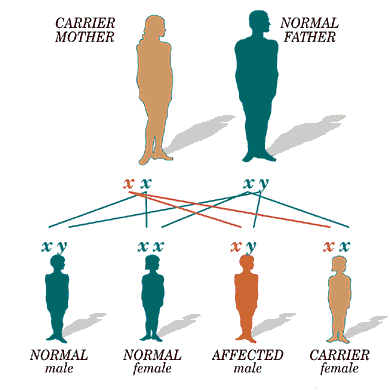
- 3-LS3-1. Analyze and interpret data to provide evidence that plants and animals have traits inherited from parents and that variation of these traits exists in a group of similar organisms.
- 3-LS3-2. Use evidence to support the explanation that traits can be influenced by the environment.
- 3-LS4-2. Use evidence to construct an explanation for how the variations in characteristics among individuals of the same species may provide advantages in surviving, finding mates, and reproducing.
Corresponding Missouri GLEs
Kindergarten3.3.D Scope and Sequence – Parent-Offspring Relationships
a. Identify that living things have offspring based on the organisms’ physical similarities and differences
2nd Grade
3.1.B Scope and Sequence – Life Cycles of Animals
a. Identify and sequence life cycles (birth, growth, and development, reproduction and death) of animals (i.e, butterfly, frog, chicken, snake, dog)
b. Record observations on the life cycle of different animals (e.g., butterfly, dog, frog, chicken, snake)
3.3.D Cycles of Animals
a. Identify and relate the similarities and differences among animal parents and their offspring or multiple offspring
3rd Grade
3.1.B Scope and Sequence – Plants
a. Describe and sequence the stages in the life cycle (for a plant) of seed germination, growth and development, reproduction, and death (i.e., a flowering plant)
3.3.D Scope and Sequence – Plants
a. Identify and relate the similarities and differences between plants and their offspring (i.e., seedlings)
7.1.A Scope and Sequence - All Units
a. Pose questions about objects, materials, organisms, and events in the environment
b. Plan and conduct a fair test to answer a question
7.1.B Scope and Sequence - All Units
a. Make qualitative observations using the five senses
b. Make observations using simple tools and equipment (e.g., hand lenses, magnets, thermometers, metric rulers, balances, graduated cylinders)
c. Measure length to the nearest centimeter, mass using grams, temperature using degrees Celsius, volume using liters
d. Compare amounts/measurements
e. Judge whether measurements and computation of quantities are reasonable
7.1.C Scope and Sequence - All Units
a. Use quantitative and qualitative data as support for reasonable explanations
b. Use data as support for observed patterns and relationships, and to make predictions to be tested
c. Evaluate the reasonableness of an explanation
d. Analyze whether evidence supports proposed explanations
7.1.D Scope and Sequence - All Units
a. Communicate simple procedures and results of investigations and explanations through:
⇛ oral presentations
⇛ drawings and maps
⇛ data tables
⇛ graphs (bar, single line, pictograph)
⇛ writings
8.2.A Scope and Sequence – All units
a. Research biographical information about various scientists and inventors from different gender and ethnic backgrounds, and describe how their work contributed to science and technology (Assess Locally)
8.3.A Scope and Sequence - All Units
a. Identify a question that was asked, or could be asked, or a problem that needed to be solved when given a brief scenario (fiction or nonfiction of people working alone or in groups solving everyday problems or learning through discovery)
b. Work with a group to solve a problem, giving due credit to the ideas and contributions of each group member (Assess Locally)
NGSS Unit 4: Forces and Interactions

NGSS Standards
- 3-PS2-1 Plan and conduct an investigation to provide evidence of the effects of balanced and unbalanced forces on the motion of an object.
- 3-PS2-2. Make observations and/or measurements of an object’s motion to provide evidence that a pattern can be used to predict future motion.
- 3-PS2-3. Ask questions to determine cause and effect relationships of electric or magnetic interactions between two objects not in contact with each other.
- 3-PS2-4. Define a simple design problem that can be solved by applying scientific ideas about magnets.
Corresponding Missouri GLEs
Kindergarten2.2.A Scope and Sequence – Changes in Position
a. Identify ways (push, pull) to cause some objects to move by touching them
b. Identify magnets cause some objects to move without touching them
1st Grade
2.2.A Scope and Sequence – Investigating Motion
a. Identify the force (i.e., push or pull) required to do work (move an object)
2.2.D Scope and Sequence – Investigating Motion
a. Describe ways to change the motion of an object (i.e., how to cause an object to go slower, go faster, go farther, change direction, stop)
2nd Grade
2.2.A Scope and Sequence – Forces and Motion
a. Identify magnets attract and repel each other and certain materials
b. Describe magnetism as a force that can push or pull other objects without touching them
c. Measure (using non-standard units) and compare the force (i.e., push or pull) required to overcome friction and move an object over different surfaces (i.e., rough, smooth)
2.2.D Scope and Sequence – Forces and Motion
a. Describe the direction and amount of force (i.e., direction of push or pull, strong/weak push or pull) needed to change an object’s motion (i.e., faster/slower, change in direction)
b. Describe and compare the distances traveled by heavier/lighter objects after applying the same amount of force (i.e., push or pull) in the same direction
c. Describe and compare the distances traveled by objects with the same mass after applying different amounts of force (i.e., push or pull) in the same direction
2.2.F Scope and Sequence – Forces and Motion
a. Compare and describe the amount of force (i.e., more, less, or same push or pull) needed to raise an object to a given height, with or without using inclined planes (ramps) of different slopes
b. Compare and describe the amount of force (i.e., more, less, or same push or pull) needed to raise an object to a given height, with or without using levers
c. Apply the use of an inclined plane (ramp) and/or lever to different real life situations in which objects are raised
3rd Grade
7.1.A Scope and Sequence - All Units
a. Pose questions about objects, materials, organisms, and events in the environment
b. Plan and conduct a fair test to answer a question
7.1.B Scope and Sequence - All Units
a. Make qualitative observations using the five senses
b. Make observations using simple tools and equipment (e.g., hand lenses, magnets, thermometers, metric rulers, balances, graduated cylinders)
d. Compare amounts/measurements
e. Judge whether measurements and computation of quantities are reasonable
7.1.C Scope and Sequence - All Units
a. Use quantitative and qualitative data as support for reasonable explanations
b. Use data as support for observed patterns and relationships, and to make predictions to be tested
c. Evaluate the reasonableness of an explanation
d. Analyze whether evidence supports proposed explanations
7.1.D Scope and Sequence - All Units
a. Communicate simple procedures and results of investigations and explanations through:
⇛ oral presentations
⇛ drawings and maps
⇛ data tables
⇛ graphs (bar, single line, pictograph)
⇛ writings
8.2.A Scope and Sequence – All units
a. Research biographical information about various scientists and inventors from different gender and ethnic backgrounds, and describe how their work contributed to science and technology (Assess Locally)
8.3.A Scope and Sequence - All Units
a. Identify a question that was asked, or could be asked, or a problem that needed to be solved when given a brief scenario (fiction or nonfiction of people working alone or in groups solving everyday problems or learning through discovery)
b. Work with a group to solve a problem, giving due credit to the ideas and contributions of each group member (Assess Locally)
4th Grade
1.2.A Scope and Sequence – Forms of Energy: Electrical Circuits
a. Construct and diagram a complete electric circuit by using a source (e.g., battery), means of transfer (e.g., wires), and receiver (e.g., resistance bulbs, motors, fans)
b. Observe and describe the evidence of energy transfer in a closed series circuit (e.g., lit bulb, moving motor, fan)
c. Classify materials as conductors or insulators of electricity when placed within a circuit (e.g., wood, pencil lead, plastic, glass, aluminum foil, lemon juice, air, water)
2.2.A Scope and Sequence – Laws of Motion
a. Identify the forces acting on the motion of objects traveling in a straight line (specify that forces should be acting in the same line as the motion, provide examples)
b. Describe and compare forces (measured by a spring scale in Newton’s) applied to objects in a single line.
c. Observe and identify friction as a force that slows down or stops a moving object that is touching another object or surface
d. Compare the forces (measured by a spring scale in Newton’s) required to overcome friction when an object moves over different surfaces (i.e., rough/smooth)
2.2.D Scope and Sequence – Laws of Motion
a. Observe that balanced forces do not affect an object’s motion (need to clarify that balanced forces means no change in forces acting on an object)
b. Describe how unbalanced forces acting on an object changes its speed (faster/slower), direction of motion, or both (need to clarify that unbalanced forces means any change in forces acting on an object)
c. Predict how the change in speed of an object (i.e., faster/slower/remains the same) is affected by the amount of force applied to an object and the mass of the object
2.2.D Scope and Sequence - Energy: Electrical Circuits
d. Predict the effects of an electrostatic force (static electricity) on the motion of objects (attract or repel)